
Fall is here, and that means that knitting season is ramping up as we dream of the perfect sweaters, hats, scarves, and mittens to keep us warm.
In honor of the season, I looked at my favorite local history resource, Illinois Digital Newspaper Collections, for mentions of one of my favorite hobbies, and what I found surprised me. Over the 150-year period from 1860 to 2019, knitting was mentioned in Champaign County newspapers more than 5,000 times. Its references wax and wane in popularity, but the interlocking knit and purl stitches are always there.
Below are some of my favorite mentions of knitting in the Champaign County newspapers.
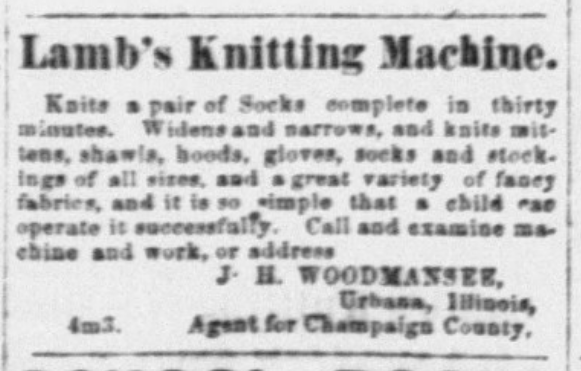
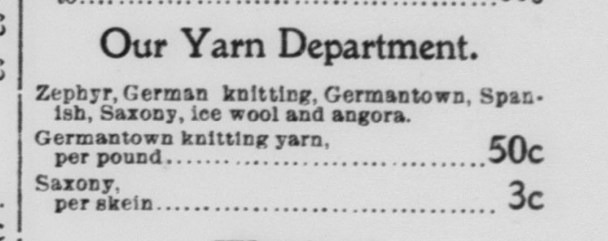
Figures 2 and 3. Champaign County Gazette, March 17, 1869 and Champaign Daily News, November 25, 1898 (left to right)
Pre-WWI newspaper coverage of knitting mostly focused on commodities for sale: personal knitting machines, yarn, needles, and notions. But the United States entry into WWI brought the Knitting Question to campus. As efforts to support European war refugees and soldiers ramped up, one way women, primarily women, supported the war effort was to knit socks and sweaters to send abroad. The ‘Knitting Question’ captured the opinion columns of The Daily Illini until even they tended to tire of it.
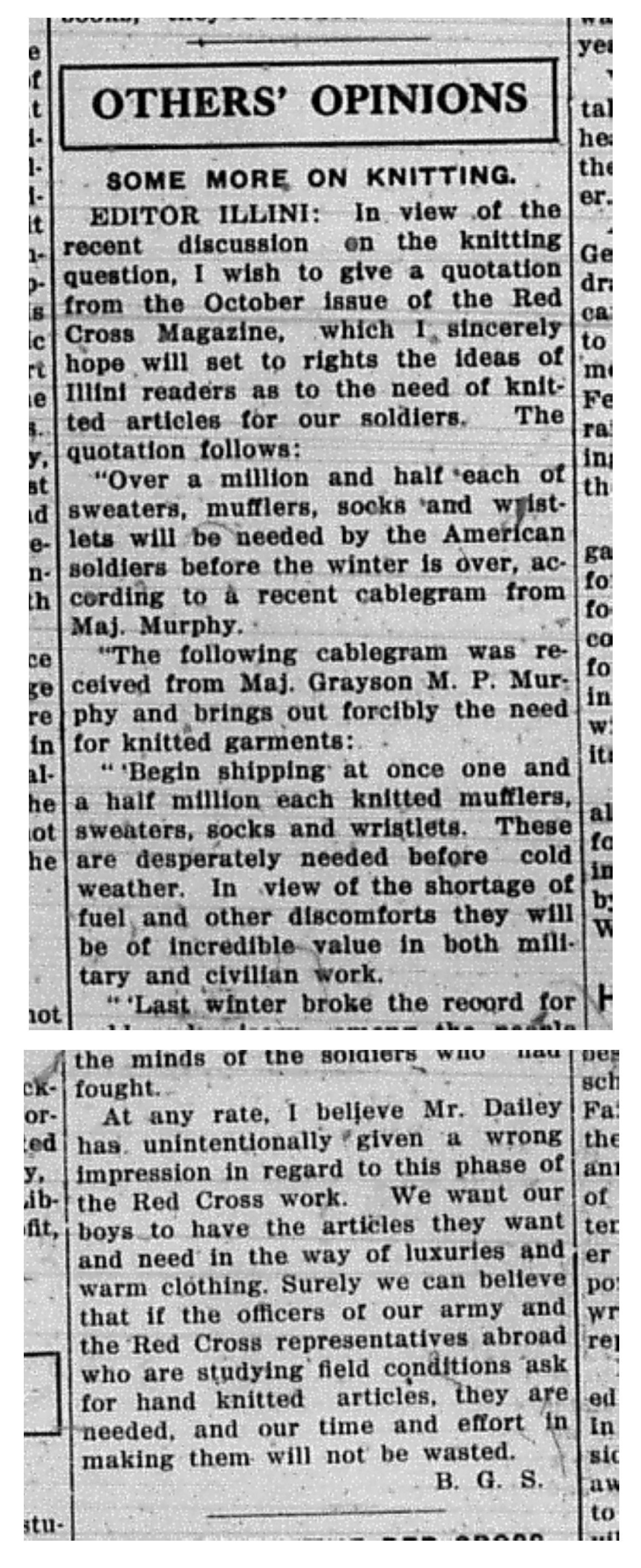
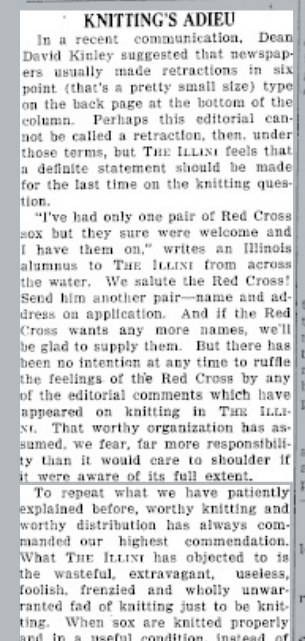
Figures 4 and 5. Dailly Illini, October 17, 1917 and Daily Illini, January 24, 1918 (left to right)
Knitting references died down in the roaring 1920s only to come back to the fore as the Great Depression overtook the land. Knitting was once again embraced by the co-eds.
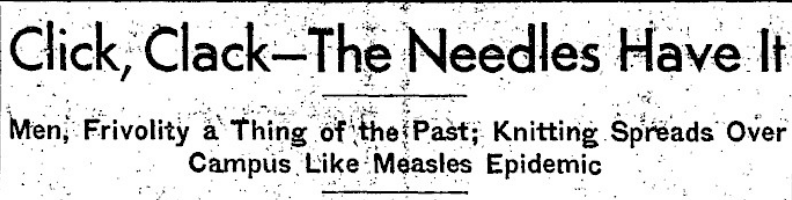
Figure 6. Daily Illini, March 8, 1935
Emily Post even chimed in and gave her blessing to knitting being allowed in classrooms.
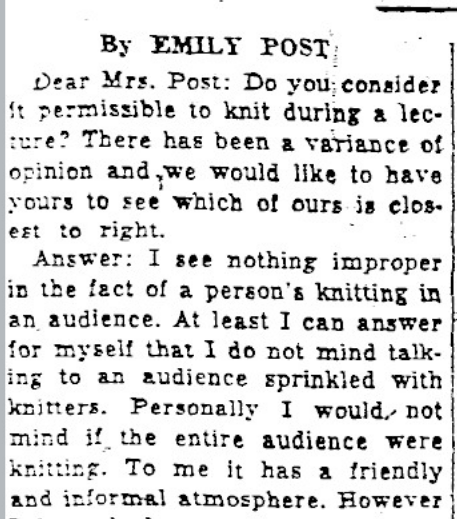
Figure 7. The Courier, October 30, 1935
Needles were once again taken up in support of the war effort during WWII, but the controversy wasn’t quite as prevalent as more women entered the workforce and the Red Cross faced a yarn shortage. The next large uptick in knitting references was in the 1960s and 1970s, as the population turned to DIY crafts and goods as a rejection of capitalism, an embrace of environmentalism, and a reframing of domestic skills as forms of artistic expression. In one article titled, “Drug display draws few students,” a multi-organizational effort to inform students about drug use and abuse hit a snag when one tabler, Will Leinicke, director of Gemini House reported fielding more questions about what he was knitting rather than questions about drugs.
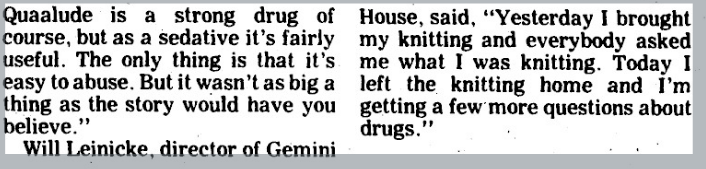
Figure 8. Daily Illini, February 22, 1973
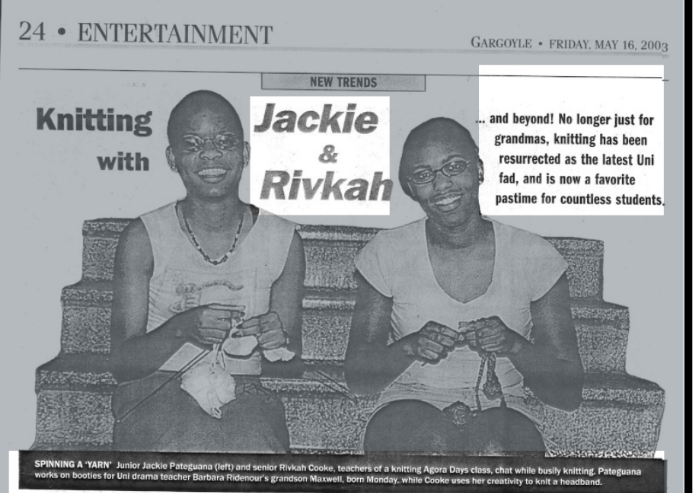
Knitting boomed again in the early 2000s, with Hollywood celebrities such as Julia Roberts, Sarah Jessica Parker, and Katherine Heigl regularly photographed knitting between takes on set, and the boom of the craft blog scene. Here are University Laboratory High School students Jackie Pateguana and Rivkah Cooke, who taught their fellow students knitting in an Agora Days class.
Looking back, it is not surprising that the interest in knitting peaks in times of chaos and uncertainty, World War I, the Great Depression, World War II, Vietnam War, and post 9/11, knitting is at its basics yarn, needles, and a knit stitch. And with those simple things, you can make a scarf for yourself or others, providing warmth and comfort.
Here is what is currently on my needles:
Stripes Recipe No. 2: The French Connection
Happy cozy season everyone!
-Sherrie Bowser
Archives librarian