
61 years ago, hundreds of nonviolent demonstrators began to cross the Edmund Pettus Bridge in Selma, Alabama, when they were brutally attacked by state troopers. Protestors were thrown to the ground, beat with clubs, and knocked out with tear gas. The moment came to be known as “Bloody Sunday,” a turning point in the Civil Rights Movement. Equality and voting rights had long been a struggle for African Americans, but the outrage towards these brutal attacks sparked sit-ins, demonstrations, and additional marches across the country, including Champaign-Urbana.
Across the University of Illinois campus and Champaign-Urbana community, students and community members came together in support of those attacked in Selma. On March 12th, campus organizations sponsored a rally on the steps of the Foellinger Auditorium, with the student chapter of the Young Democrats of America and local NAACP urging students to participate. During the demonstration, 300 students joined hands and sang “We Shall Overcome,” led by a senior at the University, Steve Downs.
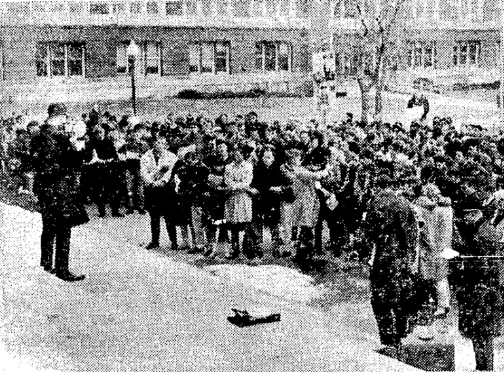
Students join hands and sing “We Shall Overcome” on the steps of the Auditorium, March 13th, 1965, from The Daily Illini, Illinois Digital Newspaper Collection.
Later that day, the demonstrators continued their protest through marching to the Western Union office in downtown Champaign, where they filled out telegrams to President Lyndon B. Johnson. Approximately 177 demonstrators sent telegrams, which urged the president to send federal troops to Selma.
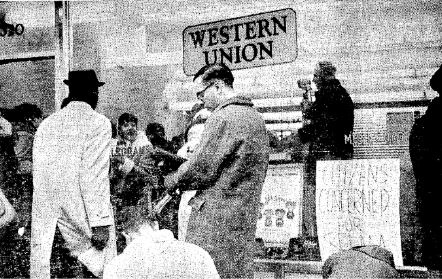
Protestors fill out telegrams to President Johnson outside of the Western Union office, March 13th, 1965, from The Daily Illini, Illinois Digital Newspaper Collection.
Across town at the Urbana Post Office, the Student Non-Violent Coordinating Committee (SNCC) organized a sit-in. Some participants were carried out of the post office by the County Sheriff’s officers and Urbana City Police on the first night, but to no avail. The demonstrators returned, and planned to sit until the president sent troops to Selma.
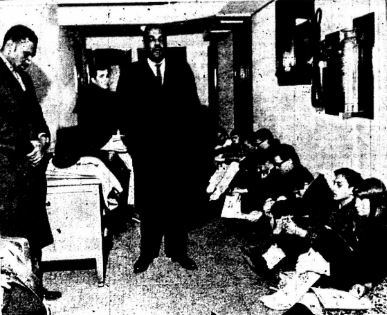
SNCC members involved in a sit-in at the Urbana Post Office being led in prayer, March 13th, 1965, from the Courier Clippings Collection.
However, protesters did not limit their efforts to the CU area. Despite the attack in Selma, dozens of students and local church members traveled to Alabama to join the “March on Montgomery.” Additional groups arrived every few days, most planning to stay until the march concluded. Their dedication to the cause outweighed their studies, with one student stating in an interview with The Daily Illini, “A degree here does not mean much if my people in the South cannot vote.”
After thousands of telegraphs, and to prevent a repeat of “Bloody Sunday,” President Johnson decided to protect those headed to Montgomery. After Alabama Governor George Wallace refused to deploy the Alabama National Guard, the president federalized the troops.
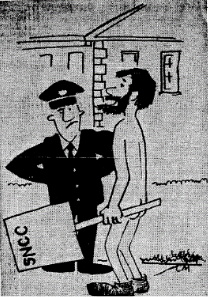
A cartoon depicting a member of the SNCC, illustrated by Craig MacIntosh, April 29th, 1965, from The Daily Illini, Illinois Digital Newspaper Collection.
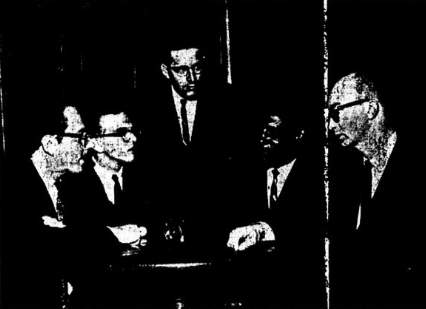
Rev. Larry Hill, Rick Soderstrom, Rev. Richard Harrison, Rev. Joseph E. Graves, and Rev. John A. Taylor recounting their experiences in Alabama after returning home from the march, March 27th, 1965, from the Courier Clippings Collection.
Back in Champaign, those who sympathized with Selma, but were unwilling to participate in the march, attended a “Selma Breakfast” organized by the Council for Community Integration at the Bethel AME Church. The breakfast included things consumed while marching: oatmeal, coffee, toast, and jam.
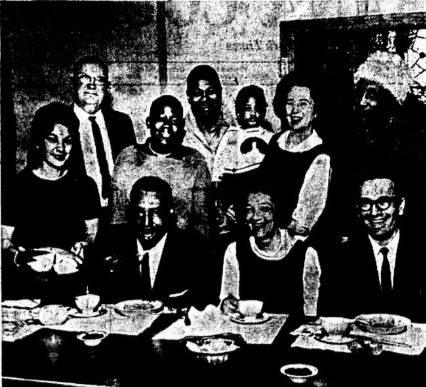
Members of the Council for Community Integration attending a “Selma Breakfast” at the Bethel AME Church, March 25th, 1965, from the Courier Clippings Collection.
Ultimately, the work done by local community members and students in protest of “Bloody Sunday” and for equal voting rights was impactful. As a result of the nationwide protests, President Johnson passed the Voting Rights Act of 1965, which prohibited discriminatory voting practices, like the poll tax and literacy tests, adopted in many southern states after the 15th Amendment. Today, Champaign-Urbana continues to fight against inequalities. This past October, community members rallied against the current administration, and in January, Urbana High School students walked out of school in protest of ICE. Even though the song, “We Shall Overcome,” is an anthem of the Civil Rights movement, the lyrics are still relevant: “Oh deep in my heart, I do believe, that we shall overcome someday.”
To learn more about community protests, visit the Archives in-person or online to learn more!
-Amelia McCarver