
Champaign County has been home to many baseball teams since the late nineteenth century. From collegiate baseball to semi-professional leagues, the county has seen many teams come and go over the years. The longest-lived league in the county, the E.I., provided a place for men of all backgrounds to come together to enjoy America’s pastime.
The Eastern Central Illinois League, or the E.I., was originally organized in the 1930s. Prior to the E.I., there were other organized baseball teams leading back to the late nineteenth century, when the short-lived minor league Champaign-Urbana Clippers played in the Illinois-Indiana League in the 1880s. The Cornbelt League of Champaign was organized during the 1920s but proved to be short-lived as well. Accounts vary on the origins of the E.I., but most agree on the presence of the Commissioners Three and involve a fateful meeting at the Bailey and Himes Sporting Goods Store in March 1933. While the cast of characters remains unclear, Shelby Himes, owner of the store, Jack Waldron, an Urbana woodworker, and Elvin Leedy were among the influential members of the brand-new league, referred to commonly as the Commissioners Three. Waldron went on to become the first president of the league. The league was initially called the Champaign County League. It was renamed to the Eastern Central Illinois Baseball League upon the addition of Rankin’s team, from neighboring Vermillion County, in 1936. However, most players and fans began referring to the league as the E.I. League, a name that has stuck since then. The initial iteration of the E.I. in 1933 had ten teams from across Champaign County. A team from Chanute Field was included in the original lineup and was reported on widely in the Chanute This Week newspaper at the time. League games occurred at baseball fields all over the county, including public parks, leased private properties, and farmers’ fields. Some teams were also able to work with the University of Illinois to utilize their facilities. Admission was not initially charged in the first few seasons, but teams began charging 25 cents for adults and 15 cents for children in the early 1940s.
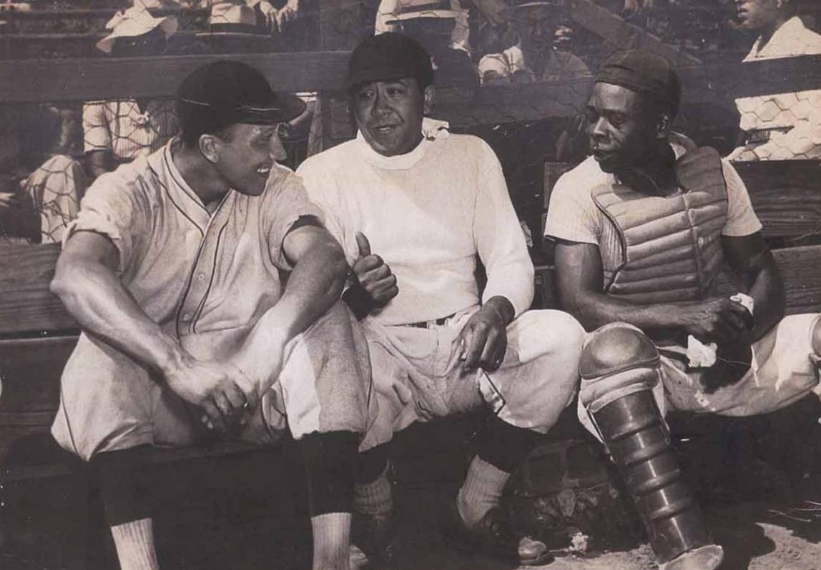
Left to Right: Ray Thomas, Eddie Glover, and Rubavent Utley. Urbana Courier, July 12, 1942.
The Champaign Colts were the first African American baseball team in the E.I., formally accepted into the league in 1941, six years before Jackie Robinson broke the color barrier in the MLB in 1947. At the time, players of color were prohibited in playing in both major and minor league teams, so many skilled players resorted to semi-pro farm leagues like the E.I. The Champaign Red Sox were an African American team organized in the area in the late 1920s as part of the Cornbelt League, but the Colts became the first Black team to join the E.I. Managed by Eddie Glover, the Colts came in with significant skill and experience, immediately becoming top contenders for the title. The Colts went on to win the 1941 championship. After a successful first year, the team was continually dogged by problems, primarily their lack of a home field. After a few attempts to construct diamonds in Thomasboro, the Colts were resigned to life as a traveling team. Their games often faced cancellation because of fluctuating location availabilities over the next few years. These difficulties, as well as a lack of players, led Himes to announce the forfeiture of their remaining league games in 1945. The team continued to have difficulties with their status as a traveling team until its eventual disbanding in 1948.
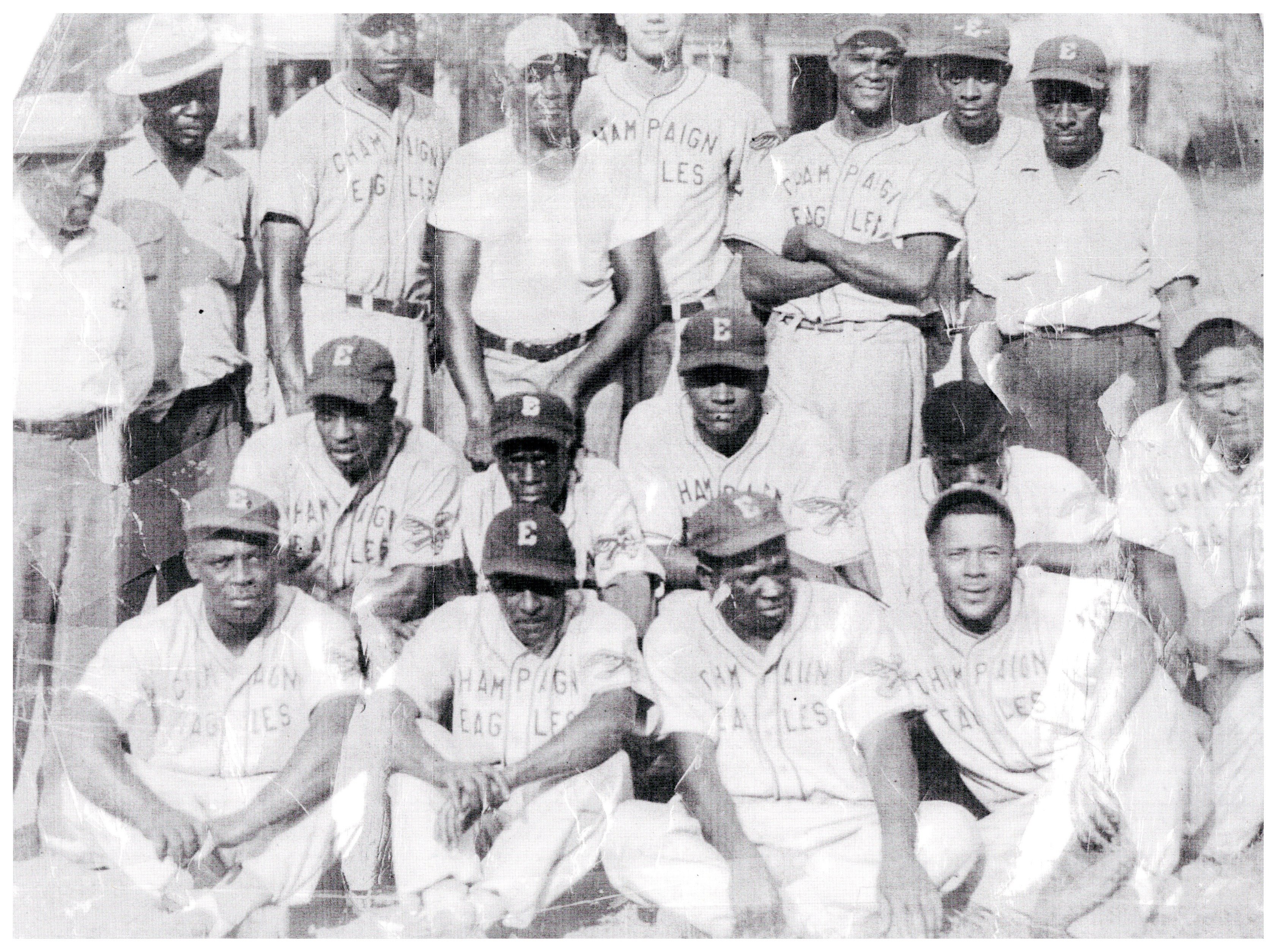
Image caption: The Champaign Eagles c. 1950s. Champaign Eagles (Baseball Team) Vertical File Folder.
The Champaign Eagles were organized in 1946 under the management of Wardell “Jack” Jackson. Formerly an umpire for the Cornbelt League, Jackson was no stranger to the local baseball scene. Like the Colts, he faced the same difficulty in finding a home field for his team. Jackson eventually landed on a corner of Douglass Park, later renamed Wardell’s Eagles Park. The Eagles played there until the late 1960s, when the Champaign Park District purchased the land to expand Douglass Park. Subsequently, they utilized Illinois Field, owned by the University of Illinois, for practicing and home games. While the university readily allowed games and practices, Jackson could not charge admission, so the team was almost entirely financed out of his personal funds. During their tenure at Eagles Park, the Eagles won multiple championships, with many players being selected for the Urbana Courier All-Stars list. Elsa “L.C.” Utley saw particular success in local baseball, starting out for the Red Sox, then playing for the Eagles after his return from World War II. The Eagles were eventually dissolved in the early 1970s, and Eagles Park fell into disrepair. However, with the efforts of Bud Johnson, the field was revitalized by the Douglass Center.
While the E.I. still exists, the roster of teams has dwindled significantly. Neither the Colts nor the Eagles survived past the heyday of semi-pro baseball in the US, but their legacies live on in Champaign County.
-Luisa Matzner
Archives Assistant